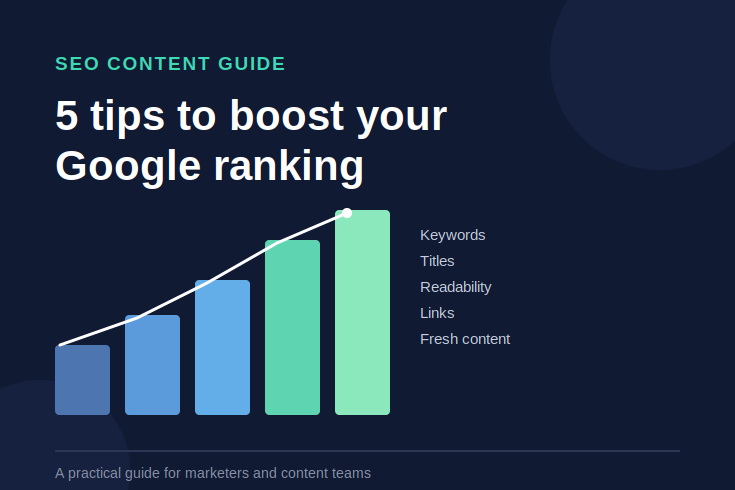
5 Content Optimization Tips to Boost Google Ranking
Publishing content isn’t the hard part anymore — everyone’s doing that. Getting Google to actually rank it above the competition is where most brands fall short. As SEO has matured, “write good content” is no longer enough advice. Here’s what experienced digital marketers actually do to move content up the SERPs.
1. Optimize for Search Intent, Not Just Keywords
Keyword stuffing died years ago, but a lot of teams still write for keywords instead of intent. Before you write a word, search the target keyword yourself and study what’s already ranking. Are the top results listicles, product pages, long-form guides, or videos? Google has already told you what format and depth it wants to reward — match it.
What to do: Categorize intent as informational, navigational, commercial, or transactional, and align your content type, structure, and CTA accordingly. A “best CRM software” page needs a comparison format with pricing, not a 3,000-word history of CRM tools.
2. Structure Content for Both Readers and Crawlers
Google’s algorithms increasingly reward content that’s easy to parse — for humans and for machines. That means clear H2/H3 hierarchies, short paragraphs, descriptive subheadings that double as mini-answers, and schema markup where relevant (FAQ, HowTo, Article).
What to do: Use one H1, logically nested H2s/H3s, bullet points for scannability, and add structured data. This also improves your odds of winning featured snippets and “People Also Ask” placements — prime real estate that drives clicks without needing the #1 spot.
3. Build Topical Authority with Internal Linking
Google increasingly ranks domains, not just pages, based on how comprehensively they cover a topic. A single great article rarely outranks a competitor with a full content cluster around the same subject.
What to do: Build pillar pages supported by related subtopic content, and interlink them deliberately. This distributes link equity, keeps users on-site longer, and signals topical depth to Google’s crawlers — a core input to modern ranking systems.
4. Prioritize E-E-A-T Signals
Experience, Expertise, Authoritativeness, and Trustworthiness aren’t just Google’s guidelines for human quality raters — they correlate strongly with what actually ranks, especially in YMYL (Your Money or Your Life) niches like health, finance, and legal.
What to do: Add author bios with real credentials, cite credible sources, update content regularly with visible “last updated” dates, and earn backlinks from reputable sites in your niche. First-hand experience — original photos, data, or case studies — increasingly outperforms generic, AI-templated content.
5. Fix Technical and On-Page Fundamentals
The best content in the world won’t rank if the page loads slowly, isn’t mobile-friendly, or has a messy meta setup. Technical SEO is unglamorous, but it’s foundational — content optimization efforts are wasted without it.
- Optimize Core Web Vitals (loading speed, interactivity, visual stability)
- Write compelling, keyword-aligned title tags and meta descriptions to improve click-through rate
- Compress images and use descriptive alt text
- Ensure mobile responsiveness — Google indexes mobile-first
- Fix broken links and orphaned pages
Final Takeaway
Ranking on Google today is less about tricking an algorithm and more about genuinely serving the searcher better than anyone else does — while making sure Google’s crawlers can recognize that you’ve done so. Intent-matched content, clean structure, topical depth, credibility signals, and technical health aren’t separate checkboxes; they compound together. Nail all five, and rankings tend to follow.