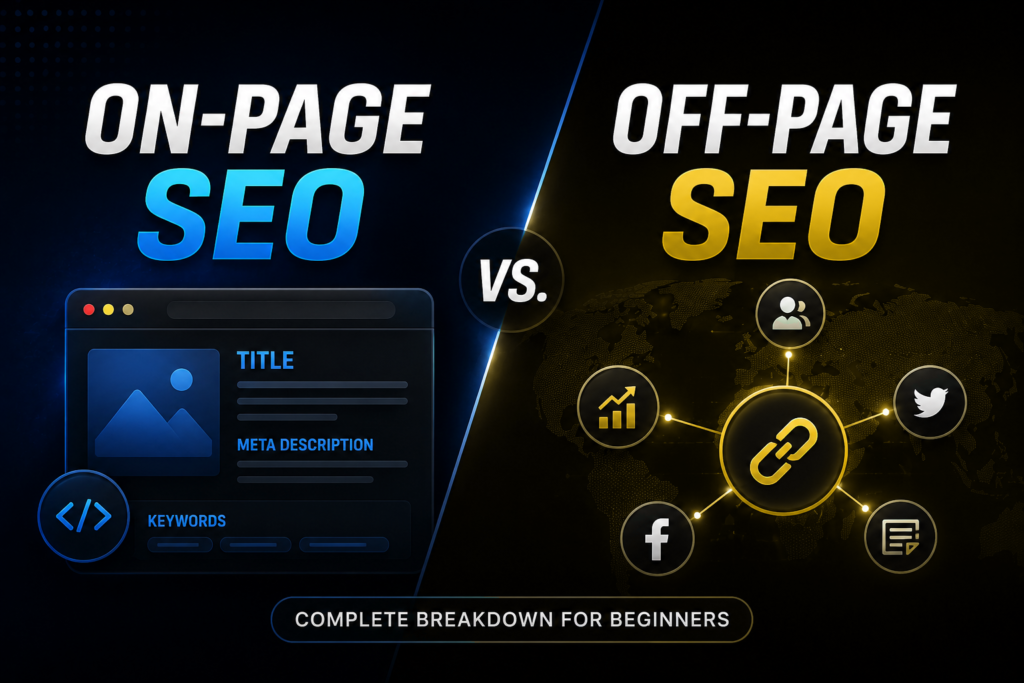
What Is On-Page SEO?
On-page SEO covers everything you control directly on your own website — the content, code, and structure of each page. It’s called “on-page” because the optimization happens literally on the page itself.
Key On-Page SEO Elements
1. Content quality and keyword targeting
Your content needs to genuinely answer the searcher’s query, not just mention the keyword. Google’s algorithms are increasingly good at detecting thin, keyword-stuffed pages versus substantive ones.
2. Title tags and meta descriptions
The title tag is one of the strongest on-page ranking signals and directly affects click-through rate from the search results page. A compelling meta description won’t boost rankings directly, but it earns more clicks — which does.
3. Header structure (H1, H2, H3)
A clean heading hierarchy helps both users and search engine crawlers understand your content’s structure. One H1 per page, logically nested subheadings beneath it.
4. URL structure
Short, descriptive, keyword-relevant URLs (/on-page-vs-off-page-seo) outperform long, parameter-heavy ones (/page?id=4471&cat=12)..
5. Internal linking
Linking between related pages on your own site distributes authority, keeps visitors browsing longer, and helps Google understand your site’s topic hierarchy.
6. Image optimization
Compressed file sizes for page speed, descriptive file names, and alt text for accessibility and image search visibility.
7. Technical performance
Core Web Vitals (loading speed, interactivity, visual stability), mobile responsiveness, and crawlability (clean sitemap, no broken links) all fall under on-page SEO’s technical side.
The marketer’s mindset: On-page SEO is where you have full control — which also means there’s no excuse for getting it wrong. Audit it regularly; small technical issues compound into major ranking drags over time.
What Is Off-Page SEO?
Off-page SEO covers everything that happens away from your website that still influences how search engines — and users — perceive your credibility. The core idea: Google doesn’t just want to know what your page says about itself; it wants to know what the rest of the internet says about you.
Key Off-Page SEO Elements
1. Backlinks
Still the heavyweight signal in off-page SEO. A link from a reputable, relevant site acts as a vote of confidence. Quality and relevance matter far more than sheer quantity — one link from an authoritative industry publication outweighs dozens from low-quality directories.
2. Digital PR and brand mentions
Getting featured in press coverage, industry roundups, or expert-contributor pieces builds authority signals even when a mention isn’t a direct link (Google increasingly recognizes unlinked brand mentions too).
3. Social signals
Social shares and engagement don’t directly boost rankings, but they extend content reach, which indirectly increases the chances of earning backlinks and traffic.
4. Guest posting and collaborations
Contributing content to respected sites in your niche builds both backlinks and brand credibility with a new audience.
5. Online reviews and reputation
Reviews on Google Business Profile, G2, Trustpilot, and similar platforms influence local SEO rankings and buyer trust — especially for local and service-based businesses.
6. Influencer and community engagement
Being cited, tagged, or discussed by voices your target audience already trusts builds real-world authority that search engines are designed to detect.
The marketer’s mindset: Off-page SEO can’t be forced — it has to be earned. Chasing backlinks through spammy directories or link farms is a fast way to get penalized. Instead, invest in content and outreach genuinely worth linking to.